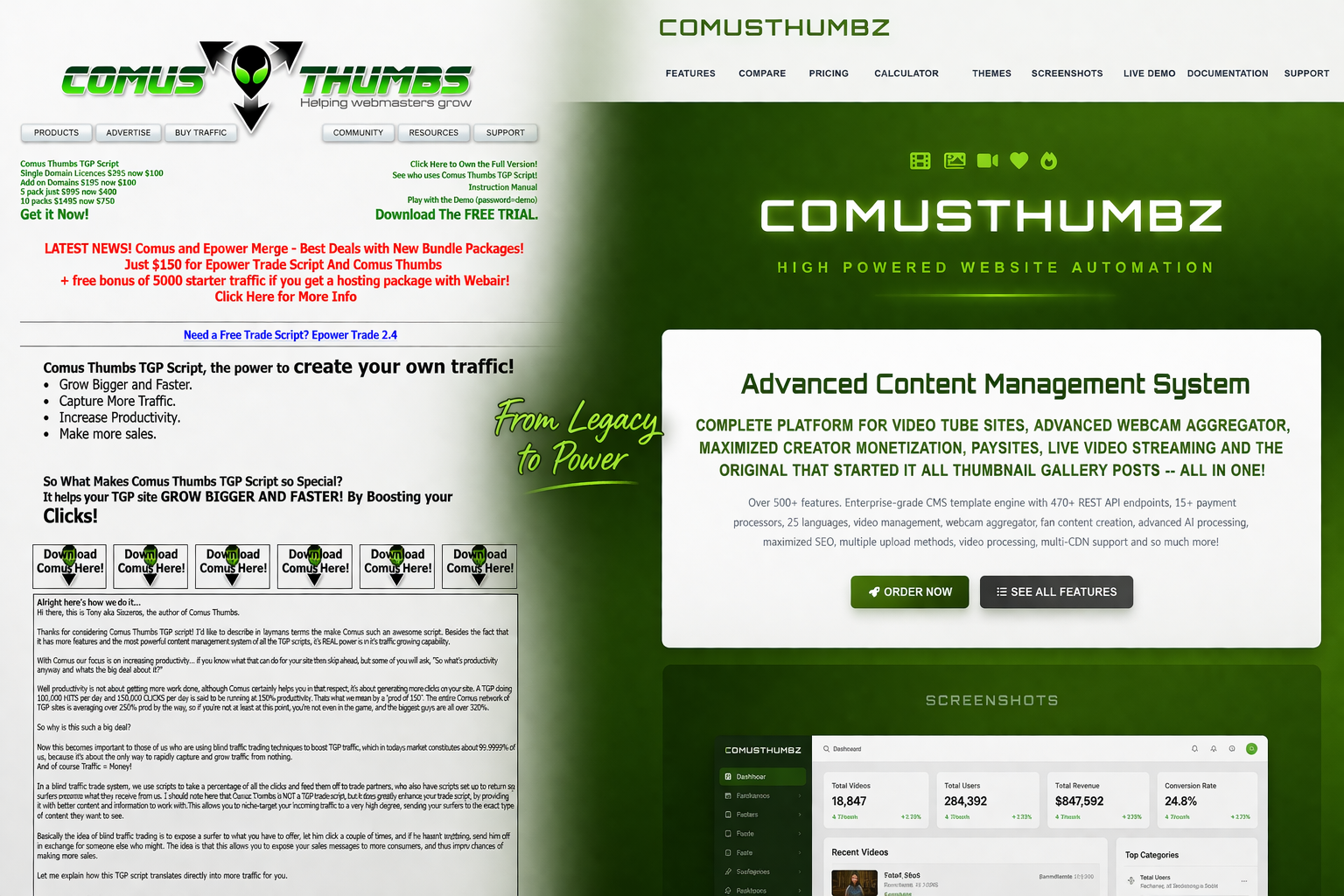
Every piece of software has DNA. A lineage that traces back to a single idea, a first line of code, a moment when someone thought, “I can build something better.” The story of ComusThumbz begins over two decades ago — not in a corporate office, but in the wild west of early 2000s adult webmastering, where ingenuity and hustle were the only currencies that mattered.
This is more than the story of one script. This is the story of an entire era — the rise and fall of the TGP ecosystem, the scripts that powered it, the community that built it, the controversies that scarred it, and how the DNA of a scrappy PHP tool called Comus Thumbs eventually evolved into the comprehensive content management system known as ComusThumbz.
Pull up a chair. This one goes deep.
Chapter 1: Before the Script — The TGP Era Explained
To understand where Comus Thumbs came from, you have to understand the world it was born into. And that world was the TGP.
What Was a TGP?
A Thumbnail Gallery Post (TGP) was a webpage that displayed rows of thumbnail images, each one linking to a “gallery” — a page containing a set of free adult images or short video clips. TGPs were essentially curated link directories for adult content, and they were the dominant distribution model for adult content on the web from roughly 1996 to 2008.
The video equivalent was called an MGP (Movie Gallery Post), but the community used “TGP” as a catch-all term for both.
Think of a TGP as the ancestor of every tube site, every content aggregator, and every recommendation algorithm you use today. It was primitive by modern standards — static HTML pages, grids of tiny thumbnails, text links — but it was the engine that drove the entire adult internet economy for over a decade.
How TGPs Actually Worked
A typical TGP site operated like this:
- A webmaster runs a TGP site (something like “Mike’s Free Pics”)
- Other webmasters (“gallery producers” or “submitters”) submit their galleries to the TGP
- The TGP displays thumbnails linking to those galleries
- The galleries contain free content but also have links to paid “sponsor” sites
- When a visitor clicks through and signs up for the sponsor, the gallery producer earns a commission
Each TGP updated once or twice daily with fresh content. Old galleries rotated off the front page. New ones took their place. The entire cycle ran on volume — more galleries meant more thumbnails, which meant more clicks, which meant more money.
The Gallery Submission Process
The gallery submission ecosystem was a business unto itself. Here’s how a gallery producer operated:
- Get free content from a sponsor program’s affiliate area (sponsors provided images and clips specifically for promotion)
- Create a gallery page with 10–20 free images and embedded sponsor links
- Generate properly sized thumbnails (usually 100x100 to 200x150 pixels)
- Submit to 200+ TGPs using mass submission tools
- Monitor which TGPs approved the gallery
- Track conversions and earnings through affiliate networks like NATS, Epoch, CCBill, or Zombaio
A well-organized gallery producer could submit to hundreds of TGPs per day. The best ones earned $10,000 to $50,000+ per month in sponsor commissions alone. This wasn’t a hobby. This was a serious business.
The Traffic Trading Economy
If galleries were the product, traffic trading was the economy. And it was sophisticated.
Traders were webmasters who exchanged traffic with each other. The concept was simple in theory:
- Site A sends visitors to Site B via a link
- Site B sends visitors back to Site A via a reciprocal link
- The goal was a 1:1 ratio — send 100 visitors, get 100 back
In practice, it was incredibly complex. Trading scripts tracked these ratios automatically, counting incoming and outgoing clicks for every partner. Some scripts would dynamically adjust link placement based on who was sending the most traffic — if Partner A was sending you twice as many clicks as Partner B, their link got better placement on your page.
Toplists took this further. A toplist was a ranked list of sites ordered by how much traffic they sent. You placed a “vote” link on your site pointing to the toplist. Each click counted as a vote. The more traffic you sent, the higher you ranked, and the more return traffic you received. It was a self-reinforcing cycle that rewarded the biggest traffic generators.
Skim: The Silent Tax
Skim was the practice of redirecting a percentage of incoming traffic to a different destination — usually a sponsor’s landing page — before the visitor reached the content they clicked on. A TGP might skim 5–20% of all incoming clicks. The visitor would see a sponsor page instead of the gallery they wanted.
This was the TGP operator’s primary monetization tool beyond banner ads. It was accepted as a cost of doing business. If your TGP was popular enough, gallery producers would accept the skim because the remaining 80–95% of traffic was still valuable.
Skim rates were a constant negotiation. Set it too high and submitters would stop sending you galleries. Set it too low and you were leaving money on the table. The best TGP operators found the sweet spot — enough skim to monetize, not so much that it drove away content.
Circle Jerks: The Dark Side
Circle jerk sites (CJs) were the scam version of TGPs. They were interconnected networks of TGP-like sites that passed traffic between each other in an endless loop. A visitor clicking through galleries would be redirected from site to site to site, with each one skimming a percentage to sponsors. The visitor would see page after page of thumbnails but never actually reach real content.
Circle jerks were widely despised — even within the adult webmaster community. But they were enormously profitable. Some CJ operators made six figures monthly by essentially trapping surfers in loops and monetizing every click. The practice was aggressive, deceptive, and one of the main reasons TGPs got a bad reputation.
The Money Was Real
The late 1990s and early 2000s were genuinely a gold rush for adult webmasters. And the numbers were staggering:
- A well-run TGP getting 50,000+ daily uniques could earn $5,000–$20,000+ per month from skim and advertising alone
- Top gallery producers earned $10,000–$50,000+ per month in sponsor commissions
- Toplist operators with massive traffic could earn six figures monthly
- The barrier to entry was absurdly low: a $10/month shared hosting account and a free TGP script could get you started
- Many operators were in their late teens and twenties, making more money than their parents ever had
At its peak, the TGP ecosystem processed billions of pageviews per month across thousands of sites. The total revenue generated through TGP traffic was estimated in the hundreds of millions of dollars annually. This wasn’t a niche corner of the internet. This was a massive economy, and it needed tools to run.
That’s where the scripts came in.
Chapter 2: The Scripts That Built the TGP Empire
Running a TGP site by hand was possible but painful. You had to approve gallery submissions manually, generate thumbnails one by one, build HTML pages, track clicks with server logs, and manage trading relationships with spreadsheets. As TGPs grew, this manual approach became impossible.
TGP scripts automated all of it. And by the early 2000s, there was a small industry of developers building these tools. Here’s the complete landscape:
AutoGallery — The People’s Script
AutoGallery was the script that launched a thousand TGP sites. Originally written in Perl/CGI with flat-file storage, it was free — and that single fact made it the most widely deployed TGP script in the late 1990s and early 2000s.
AutoGallery did the basics: it processed gallery submissions, generated thumbnail pages, handled category organization, and built output pages automatically. If you wanted to start a TGP in 2000 and had zero budget, AutoGallery was your only real option.
The free version had real limitations, though. The flat-file storage system buckled under heavy traffic. Security was minimal. Features were basic compared to what would come later. But it didn’t matter — AutoGallery democratized TGP ownership. Suddenly anyone with $10 hosting and a weekend to learn could run a TGP.
AutoGallery SQL came later, upgrading to MySQL-backed storage for better performance and scalability. AutoGallery Pro added enhanced submission controls and anti-cheat features. But by the time these paid versions arrived, the competition had stiffened considerably.
Language: Perl/CGI (later PHP/MySQL) | Price: Free (Pro/SQL versions $50–$150) | Peak era: 1999–2005
TGPX by JMB Software — The Professional’s Choice
If AutoGallery was the Toyota Corolla of TGP scripts, TGPX was the Mercedes. Developed by JMB Software (Josh, based in the Boston area), TGPX was the gold standard of commercial TGP software.
TGPX had everything: automated gallery submission and approval, thumbnail caching and downloading, sophisticated anti-cheat detection, a template system with Smarty-like tags, cron-based page building that generated static HTML for speed, sponsor rotation and skim control, reciprocal link verification, blacklisting, and built-in analytics.
The anti-cheat system was TGPX’s crown jewel. Gallery submitters constantly tried to game TGP scripts — submitting duplicate galleries with slightly different URLs, using “cheater pages” that showed different content to the script’s checker than to real visitors, uploading fake thumbnails, using redirects to hijack traffic. TGPX could detect most of these tricks through thumbnail verification, URL pattern analysis, submitter reputation scoring, and shared blacklists.
On GFY.com (the dominant adult webmaster forum), “Just get TGPX” was the standard advice to anyone asking about TGP scripts. JMB Software had excellent support and regular updates. The script was robust, well-documented, and highly customizable. If you were serious about running a TGP, this was the script to use.
JMB Software also made LinksList, the go-to script for toplist sites, creating an ecosystem of complementary tools. TGPX was eventually open-sourced when its creator moved on, and the code still lives on GitHub as a historical artifact.
Language: Perl, later PHP | Price: $149–$199 | Peak era: 2003–2012
Smart Thumbs — The Polished Challenger
Smart Thumbs by Smart-Scripts.com was the primary commercial competitor in the TGP script space. At $250 for a first copy ($200 second, $150 third, plus $40 optional installation), it was a premium product — and it earned its price.
Smart Thumbs claimed to power more than 19,000 TGP sites and was tested on installations handling 1,120,000 hits per day. Its feature set was comprehensive: gallery scanning for malicious code detection, built-in traffic analyzer, pay spots for premium placements, sponsor-specific skim percentages, partner account management, Java and Flash cropping tools, and multi-domain support.
One telling detail: Smart Thumbs’ own marketing referenced “ImageMagick support for sharpening images (like Comus Thumbs)” — an acknowledgment that Comus Thumbs was a known quantity in the market, a benchmark feature that competitors felt compelled to match.
Smart Thumbs had a free version with a traffic skim (same model as Comus Thumbs) and a paid version without. A key selling point was reliability: if MySQL went down temporarily, Smart Thumbs could keep serving static main pages. For operators running high-traffic TGPs, that kind of resilience mattered.
Language: PHP/MySQL | Price: $250 (or free with skim) | Peak era: 2004–2009
TGS (Toxic Gallery System) — The Anti-Cheat Specialist
TGS by T-Scripts.com was a Perl-based commercial TGP script that positioned itself on reliability and anti-cheat protection. At $1,200, it was one of the most expensive options available — but it backed up the price tag with features like automated dead-link checking every five minutes, MySQL-backed gallery management, advanced duplicate detection, thumbnail verification and caching, and sophisticated submission processing.
TGS had a loyal user base that valued its proactive monitoring. While most TGP scripts checked galleries only at submission time, TGS continuously monitored for galleries that went offline, changed content, or started redirecting. For operators who ran clean, high-quality TGPs, this was worth the premium.
Language: Perl/CGI, PHP/MySQL | Price: ~$1,200 | Peak era: 2003–2010
The Rest of the Field
The TGP script landscape was crowded with smaller players, each carving out a niche:
- Aardvark TGP — A free, open-source Perl script. Basic functionality, modest user base, but the name was memorable. It served the same entry-level market as AutoGallery. (Perl/CGI, Free, ~2001–2006)
- Celestial TGP — Part of the Celestial Scripts brand that produced several adult webmaster tools. Commercial, moderately known, decent features. (Perl/CGI, Commercial, ~2000–2006)
- FTGPS (Free TGP Script) — Exactly what the name says. Very basic, minimal admin interface, but appealed to beginners who were put off by more complex options. One user described it as “very easy to use even for a beginner.” (Perl/CGI, Free, ~2000–2005)
- X3 TGP — A PHP/MySQL script that briefly gained notoriety when it was promoted as a replacement for Comus Thumbs after the Tony controversy. Minor player overall, but it had its moment. (PHP/MySQL, ~$99, ~2004–2008)
- TGPSoft — A desktop application for building TGP pages, rather than a server-side script. Used for creating and submitting galleries to TGP sites. Different approach, small user base. (Desktop app, Commercial, ~2003–2007)
- Fetchgals — Notable for its automated gallery discovery approach — it would crawl and import galleries rather than relying solely on submissions. One user described it as “a disaster,” so the execution may not have matched the concept. (Perl/CGI, ~2001–2005)
- ZippedTGP — A niche PHP script handling ZIP-based gallery imports. Not widely adopted. (PHP, ~2002–2006)
- RaTGP — Basic TGP functionality with gallery rotation and category management. Very minor player. (PHP, ~2003–2007)
- LinksList by JMB Software — Not strictly a TGP script but the dominant toplist script. Used for ranked link directories and traffic exchanges. Part of the JMB ecosystem alongside TGPX. (Perl/PHP, $99–$149, ~2001–2012)
Beyond the TGP scripts themselves, an entire ecosystem of supporting tools existed: Gallery Submitter Pro for mass-submitting galleries to hundreds of TGPs at once, CJ Flash and CJ Ultimate for circle jerk traffic management, trading scripts like TradePulse and TradeExpert for managing traffic exchange ratios, and toplist managers like ETM. Affiliate tracking platforms like NATS by Too Much Media became the backbone of sponsor commission tracking.
This was a genuine industry, with real money, real competition, and real innovation.
Chapter 3: Enter Comus Thumbs
2003: A Script Appears on nibbi.net
In 2003, a PHP script appeared on nibbi.net — a developer resource site that distributed free scripts and tools. It was listed on the PHP Resource Index under “Programs and Scripts > Images/Graphs > Photo Albums and Management.” The script was called Comus Thumbs.
From the beginning, Comus Thumbs was different. While most TGP scripts at the time were written in aging Perl/CGI, Comus Thumbs was built in PHP — the language that was rapidly becoming the web’s favorite. And while the free alternatives (AutoGallery, Aardvark, FTGPS) offered bare-minimum functionality, Comus Thumbs arrived with a feature set that rivaled the commercial options.
It was free. It was powerful. And it was built in the right language at the right time.
2004–2005: ComusThumbs.com Goes Live
By 2004, Comus Thumbs had outgrown its origins as a script on someone else’s site. It got its own home at comusthumbs.com and began marketing itself with a bold claim: “The leading Free Thumbnailing TGP Script used by adult webmasters.”
A separate listing on ScriptsFinder went further: “One of the fullest featured free TGP scripts on the market. Run a high traffic TGP site with one simple application, with powerful administrative tools that help ensure only the highest quality links show on your site.”
These weren’t empty claims. Comus Thumbs delivered features that justified the swagger.
The Feature Set That Made It King
What set Comus Thumbs apart wasn’t any single feature — it was the completeness of the package. Here’s what you got for free:
Traffic Booster AI — This was the headline feature, and it was genuinely innovative for the era. The Traffic Booster analyzed surfer behavior in real-time and automatically adjusted which content was displayed to maximize traffic growth. It tracked what visitors clicked, identified the most engaging content, and promoted it more prominently. Today we’d call this a recommendation algorithm. In 2004, it was called “AI” — and while it was primitive compared to modern machine learning, the concept was exactly right.
Macro Wizard — The code generation engine that powered the display system. Accessed via Pages > Macro Wizard, it had configurable “Rule Sets” and a “Find Best By” option that defaulted to CTR (click-through rate) weighting. The Macro Wizard could weight thumbnails by popularity, newness, or other criteria, generating the display code that determined how galleries appeared on the page. Version 2.51 had a known bug where the Macro Wizard wouldn’t auto-replace category selection, requiring manual substitution — a quirk that made the comusdesign blog’s tutorials particularly valuable.
ProdBooster / Hall of Fame — A display mode within the Macro Wizard that showcased the most popular thumbnails. The recommended setting was “Prodbooster 10min Hall of Fame,” which updated the top gallery every 10 minutes based on click performance. Other galleries on the same page were recommended to use matching 10-minute intervals. If there weren’t enough high-performing thumbnails yet, blank spots would appear — an honest indicator that your site needed more traffic before the system could work its magic.
Auto Thumbnailer with ImageMagick — Automated thumbnail generation with sharpening via ImageMagick integration. This was noteworthy enough that Smart Thumbs (the $250 competitor) specifically mentioned it in their own marketing: “ImageMagick support for sharpening images (like Comus Thumbs).” When your competitor references your feature as the benchmark, you’re doing something right.
Sponsor Gallery System — Two methods for importing galleries:
- Easy Method: Navigate to Import > Sponsor Galleries, browse the pre-listed sponsors, sign up with a partner code, hit “Change Codes” to verify, and click “Install.” Comus would automatically import all of that sponsor’s galleries. This was remarkably streamlined for the era.
- Hard Method: Use the Bulk Importer for sponsors not pre-listed in the system. Configure the sponsor’s link generator to dump data in a delimited format ([URL]; [Thumb URL]; [Description]), set the matching field delimiters in Comus, and import. Sponsor codes could be mass-added using Notepad’s Replace All function before pasting.
Gallery Review Control — A verification interface for auditing imported galleries. After import, you could search by specific criteria (like sponsor codes) to confirm that thumbnails displayed correctly and links contained proper affiliate tracking. The URL Scanner complemented this by crawling all currently displayed galleries to verify thumbnail links.
Page Builder — The output generation system. Navigate to Pages > Page List, select the “Prod Booster” template, set a Page Source (.tmpl file) and a Target File (like “../../index.html”), edit the template with a pencil icon, replace the header code with your generated Macro Wizard output, and click “Make.” The system would generate the final HTML pages. Template files needed 777 permissions on the server.
Click Tracking — Built-in CTR analytics for measuring gallery performance. This data fed back into the Traffic Booster AI and ProdBooster systems, creating a feedback loop: popular content got promoted, which generated more clicks, which further confirmed its popularity.
Bulk Review — Batch processing of gallery records, configurable to handle 50–100 records at a time via Special Commands. Essential for operators managing large gallery databases.
Category System — Organize galleries into niches (amateur, blonde, ebony, etc.) with search and filtering. The system worked but had rough edges — the version 2.51 category bug required manual intervention when using the Macro Wizard for category-specific pages.
Thousands of Ready-to-Go Galleries — The script shipped with a pre-loaded gallery database, so you could have a functional TGP site immediately after installation without having to wait for submissions. This was a huge selling point for newcomers who wanted to see results before investing time in the gallery submission ecosystem.
The Business Model: Free with a Skim
Comus Thumbs operated on the same freemium model as several competitors. The free version included a traffic skim of approximately 1.5–2% — meaning that percentage of visitor clicks would be redirected to the developer’s own monetization. A paid version (listed as “Comus TGP” on ScriptsFinder at $50) removed the skim entirely.
This model was standard industry practice. Smart Thumbs had the same free-with-skim / paid-without structure. Wikipedia’s TGP article specifically noted: “Some free TGP scripts are financed by occasional redirecting of surfers to a site under the control of the script’s programmer.”
At 1.5–2%, the skim was modest — far less aggressive than what many TGP operators applied to their own traffic. For webmasters with zero budget, losing 2% of clicks in exchange for a fully-featured TGP script was a deal. For those who wanted full control, $50 eliminated the skim entirely. Either way, the operator won.
Why It Was King
So where did Comus Thumbs fit in the hierarchy? Let’s be direct about it.
In the commercial TGP script space, TGPX was the undisputed champion. If you were spending $150–$200, you bought TGPX. Period.
But in the free TGP script space — which was the much larger market, because most webmasters were bootstrapping on minimal budgets — Comus Thumbs was the king.
AutoGallery was older and more widely deployed by sheer inertia, but it was a Perl relic with flat-file storage that buckled under real traffic. FTGPS and Aardvark were too basic to run serious TGPs. Fetchgals was unreliable. The other free options were barely maintained.
Comus Thumbs was the only free script that could credibly compete with the paid options. The Traffic Booster AI had no equivalent in any other free tool. The ImageMagick integration was good enough that the $250 Smart Thumbs felt compelled to match it. The sponsor gallery system with one-click import was genuinely ahead of its time. The ProdBooster analytics-driven display system presaged the recommendation algorithms that would later power every major content platform on the internet.
The comusdesign blog’s author summarized it perfectly: “My favorite TGP/MGP system simply because of its power and flexibility.”
That power came with complexity — the same author acknowledged the script “can be overwhelming to understand how it all works and put everything together” — but for operators who put in the time to learn it, Comus Thumbs punched well above its weight class.
It was listed on the PHP Resource Index, FreeScripts.com, ScriptsFinder, 1PHPScripts.com, and Matt’s Script Archive. Freelancers on Freelancer.com took on customization jobs for Comus Thumbs installations — everything from paging implementations to template customization to troubleshooting thumbnail redirect issues. That kind of third-party ecosystem doesn’t develop around forgettable software.
Chapter 4: The Community That Built It All
GFY.com: The Center of the Universe
GFY.com (GoFuckYourself.com, also known as “GoofyBucks”) was the central gathering place for adult webmasters. Founded around 1998, it grew into the largest adult webmaster forum on the internet.
GFY was crude, profane, and frequently hostile — the name tells you everything about the culture. But beneath the shock-value exterior was a surprisingly functional community. Script reviews, traffic trading strategies, sponsor program evaluations, SEO techniques, and genuine technical help coexisted with legendary feuds, ruthless trolling, and some of the most colorful drama the early internet ever produced.
The forum had a meritocratic ethos. Your traffic numbers and earnings defined your status. Nobody cared about your credentials, your age, or your background. If your TGP was pulling 100,000 uniques a day, you had respect. If it was pulling 500, your opinions were worth exactly what you paid for them.
GFY also served as a community watchdog. “Outing” scammers and cheaters was considered a public service. When a script developer screwed someone over, when a sponsor didn’t pay commissions, when a webmaster submitted cheater galleries — GFY was where the truth came out. The forum’s “rep” system and established-member vouching created an informal trust network that governed business relationships across the industry.
The Conferences
The community gathered in person at several major events:
- Internext — The biggest adult webmaster trade show, held in Las Vegas, Hollywood, and other cities. Panels on traffic trading, SEO, and monetization. Sponsor booths. Script demonstrations. Networking events that were legendary for their excess. This was where the deals got done.
- The Phoenix Forum — Held in Scottsdale/Phoenix, Arizona. More intimate than Internext, known for high-level networking and serious deal-making among established operators.
- Webmaster Access — Another significant gathering, moving between cities.
- XBIZ Summit / XBIZ Show — Business-focused events by the XBIZ trade publication, the most significant B2B media outlet covering the adult entertainment industry.
- AVN Show — The Annual AVN (Adult Video News) convention in Las Vegas, including the AVN Awards (“the Oscars of adult entertainment”). More content-industry focused but with strong webmaster attendance.
Many webmasters knew each other only by screen names for years before meeting in person at these events. The disconnect between anonymous online personas and real-world identities was part of the culture — and a practical necessity, given the social stigma of working in adult content.
The Culture
The adult webmaster community of this era had a distinct character:
- Demographics: Overwhelmingly male (95%+), many self-taught programmers and system administrators, global distribution (US, UK, Netherlands, Germany, Russia, Eastern Europe), age range typically 18–40
- Brutal honesty: Sugar-coating didn’t exist. If your site sucked, people said so. If your script had a bug, the forum roasted it
- “Rising tide” philosophy: Surprisingly, there was a genuine ethic of sharing knowledge freely. Experienced operators would spend hours helping newcomers, because more quality TGP sites meant more traffic in the overall ecosystem
- The dark side: Content theft was rampant. Chargebacks and payment processor freezes were constant headaches. Legal concerns around age verification and 2257 compliance hung over everything. Some operators engaged in browser hijacking and malware distribution. And the social stigma meant many webmasters couldn’t tell friends or family what they did for a living
Despite the rough edges, this community built something remarkable. The technical innovations they pioneered — traffic trading algorithms, skim systems, automated content management, affiliate tracking, recommendation engines — influenced mainstream web development in ways that are rarely acknowledged.
Chapter 5: The Tony Era and the Controversy
At some point in its history, Comus Thumbs came under the stewardship of a person known in the community simply as “Tony.” Tony ran comusthumbs.com and became the public face of the software.
The Allegations
The adult webmaster community has a long memory. And Tony’s name became associated with a controversy that spread across the community watchdog sites.
The most detailed account appeared on OfficialShitList.com, a site dedicated to calling out bad actors in the adult webmaster space. The post titled “X3 TGP: Repaying ComusThumbs & Tony’s Debt” laid out the core allegation:
Friends of the site’s operators ran an animal rescue shelter. The shelter was reportedly operating solely on the operators’ personal paychecks, with approximately 50 permanent animal residents whose lives depended on continued funding. They contacted Tony at comusthumbs.com about building a database system to help raise money for the animals.
According to the allegation, Tony took the money and failed to deliver. The Official Shit List reported receiving “no response from Tony at comusthumbs,” adding that “most thieves don’t have consciences or they wouldn’t be thieving lowlifes.”
The Fallout
The community response was swift and damaging. The Official Shit List promoted X3 TGP as an alternative script, pledging to “donate all proceeds from this affiliate to their friends’ rescue fund” — effectively using X3 sales as a way to offset Tony’s alleged wrong.
Commenters piled on. Users described Comus Thumbs as “too much trouble” and declared X3 “better and working faster.” Others stated they would refuse to do business with Tony because of the shelter allegations. The site published follow-up posts, including one titled “Defending the Indefensible. Predictable!” — suggesting Tony or his supporters had attempted to rebut the claims.
In a community governed by reputation and trust, the damage was severe. GFY’s watchdog culture meant that once you were labeled a bad actor, the label stuck. Forum search results, directory listings, and community memories would carry the stain indefinitely.
The Rating Tells a Story
On FreeScripts.com, Comus Thumbs carried a rating of 3.26 out of 10. That’s a devastating score for software that had genuinely innovative features. But rating systems on community sites didn’t just measure code quality — they reflected the community’s overall sentiment about the product and the people behind it. The Tony controversy almost certainly dragged that number down.
Our Position
We want to be absolutely clear: the current ComusThumbz team has no connection to Tony or the previous comusthumbs.com operation.
We are new creators. We came to this project with fresh eyes, clean hands, and over 30 years of experience in the adult online business. We chose the name ComusThumbz (with the “z”) to honor the DNA of the original software — the clever ideas, the innovative features, the scrappy engineering that was ahead of its time — while making it unmistakably clear that this is something entirely new.
We don’t know Tony. We didn’t work with Tony. We aren’t Tony. What happened between Tony and that rescue shelter is between Tony and his conscience. What we can tell you is that the software concept — the idea that adult webmasters deserve powerful, feature-rich tools — was always sound. The execution just needed new hands.
Chapter 6: 2010 — The Hack, The Fall, and the Death of an Era
The Hack
In 2010, comusthumbs.com suffered a devastating hack. The breach compromised the site infrastructure and effectively killed development. Updates stopped. Support vanished. The domain eventually went dark.
The FreeScripts.com listing was last updated on September 18, 2008, suggesting development had already slowed before the final blow. The PHP Resource Index listing shows activity as late as October 13, 2010. Somewhere in that window, the hack occurred, and Comus Thumbs went silent for good.
Combined with the Tony controversy and the declining TGP market, there was simply no one left with the motivation or the trust to keep the project alive.
The Bigger Death: TGPs Themselves
But Comus Thumbs didn’t die alone. It died alongside the entire TGP ecosystem. And the killer had a name: tube sites.
The timeline of destruction:
- 2006: YouTube launches and proves that streaming video on the web is viable at scale. Adult entrepreneurs immediately recognize the potential.
- August 2006: YouPorn launches — one of the first major adult tube sites
- 2007: Pornhub, RedTube, Tube8, and xHamster all launch. The flood begins.
- 2007–2008: Tube site traffic explodes. They rapidly surpass TGP traffic volumes. Why browse thumbnails linking to external galleries when you can stream video directly in your browser?
- 2008–2009: Google starts ranking tube sites higher than TGPs in search results. TGP organic traffic collapses.
- 2009–2010: Mass exodus from TGPs. Sites shut down or attempt to convert to tube format.
- 2010–2012: TGPs are effectively dead as a mainstream traffic model. A few niche holdouts persist, but the era is over.
Why Tubes Won
The tube model didn’t just beat TGPs — it annihilated them. The advantages were overwhelming:
- Better user experience: Streaming video on-page versus clicking through thumbnail links to external pages. No contest.
- User-generated content: Anyone could upload, creating massive content libraries that no TGP could match
- No click-through frustration: TGPs often led to spam, redirects, circle jerks, and dead links. Tubes delivered content immediately.
- SEO dominance: Tube sites generated enormous amounts of indexable content — video titles, descriptions, tags, categories, comments — that ate TGP search rankings alive
- Free streaming video: The public’s appetite for free, instant video content was insatiable
- Embed culture: Tubes allowed embedding, facilitating viral sharing across forums, blogs, and social media
- Better monetization: Pre-roll ads, overlay ads, and premium upsells proved more effective than TGP sponsor links
The irony is that tube sites used many of the same monetization strategies (skim, redirects, advertising) but wrapped them in a dramatically better user experience. The TGP model wasn’t killed by a different philosophy — it was killed by better execution of the same philosophy.
The Community Adapts
The webmaster community didn’t die with TGPs. It adapted:
- Many TGP operators pivoted to running tube sites
- Some moved into affiliate marketing for the new tube platforms
- Others leveraged their traffic trading expertise into mainstream digital marketing
- GFY.com remained active but shifted its focus from TGP trading to tube site discussion, SEO, and general industry business
- The conferences continued but with different attendee profiles and different conversations
- The “small operator” TGP webmaster was largely replaced by larger operations running tube sites
The era of the independent TGP operator running a profitable site from a $10 hosting account was over. The new tube economy required more capital, more infrastructure, and more sophisticated technology. The barrier to entry — once so famously low — had risen dramatically.
Chapter 7: What Came After — The Tube Script Era
As TGP scripts faded, a new generation of adult CMS software rose to take their place. The market shifted from managing thumbnail galleries to managing video content at scale.
KVS (Kernel Video Sharing) — The New King
If TGPX was the king of TGP scripts, KVS (Kernel Video Sharing) became the undisputed king of tube CMS platforms. Developed by an Eastern European team, KVS is the most widely used self-hosted adult tube CMS in the world.
KVS is a complete YouTube-like tube platform with video uploading, conversion, streaming, embedding, SEO tools, monetization systems, CDN integration, multi-server support, content grabbing/importing from other tube sites, satellite site systems, plugin architecture, and mass video import tools. It ranges from a free tier to $1,500+ for the Ultimate license.
KVS powers thousands of tube sites, including many well-known names. Its dominance in the self-hosted tube market is comparable to what TGPX achieved in the TGP space — it’s the default answer to “what script should I use?”
Adult Script Pro
Adult Script Pro represents the modern PHP approach — built on the Laravel framework rather than custom PHP, it offers video, photo, and webcam support with responsive design, SEO tools, multi-language support, payment integration, and a clean admin panel. At $299–$499+, it appeals to developers who want a framework-based solution they can extend using modern PHP conventions.
Other Modern Options
- JEEZ CMS — Adult content management with video and gallery support. Smaller market presence.
- Starter Tube — Budget tube solutions aimed at beginners. Basic functionality, low cost.
- WordPress with adult themes — Some operators use WordPress with specialized adult themes (ModelTheme, etc.) and video plugins. Surprisingly viable for smaller operations.
- Mass embed scripts — Scripts that create tube sites from embedded content from other platforms. Controversial (essentially scraper sites) but widespread.
- Custom builds — Many major tube sites run entirely custom platforms built by in-house development teams.
What’s Missing
Here’s the thing about the current landscape: most of these tools solve only one part of the problem. KVS is a tube platform — great for video, limited for everything else. Adult Script Pro is modern but narrow. WordPress hacks are fragile and limited.
None of them deliver what the modern adult content industry actually needs: a comprehensive platform that handles video, photos, live streaming, creator monetization, community features, analytics, multi-CDN distribution, payment processing, and content management — all in one integrated system.
That’s the gap that ComusThumbz was built to fill.
Chapter 8: The DNA Lives On — ComusThumbz Is Born
Good ideas don’t die. They wait for someone who can execute them properly.
When we set out to build ComusThumbz (note the “z”), we weren’t trying to resurrect a TGP script. That era is over, and we have no interest in pretending otherwise. We were building a modern, comprehensive content management system for the adult industry — one that reflects how the business actually works in the 2020s.
But we recognized that the original Comus Thumbs, despite its troubled history, had planted seeds that still matter. Ideas that were ahead of their time. Concepts that the rest of the internet eventually adopted without knowing where they came from.
The DNA Connections
Every major feature in ComusThumbz has a spiritual ancestor in the original Comus Thumbs:
Click Tracking → Complete Analytics System
Comus Thumbs tracked clicks and CTR before “analytics” was even a word most webmasters used. The original’s click tracking fed into ProdBooster and the Traffic Booster AI, creating data-driven content decisions. ComusThumbz has a complete analytics system with impressions tracking, click tracking through a universal click gateway (click.php), content performance metrics, and traffic management. The lineage is direct.
Traffic Booster AI → SEO & Traffic Management
The Traffic Booster AI was primitive — basic behavioral analysis adjusting gallery display in real-time. But the concept was exactly right: use data about what visitors engage with to optimize what you show them. ComusThumbz includes sophisticated SEO management with dynamic meta templates, Open Graph optimization, automated sitemap generation, and a license-based traffic skim system that’s transparent, configurable, and fair.
Auto Thumbnailer → FFmpeg Pipeline
It’s literally in the name — Thumbs. The original generated thumbnails with ImageMagick. ComusThumbz generates timeline thumbnails, animated GIF previews, poster images, contact sheets, and preview clips — all automatically via a full FFmpeg/FFprobe processing pipeline with HLS streaming output. Same concept, exponentially more capable.
Macro Wizard → Template Management System
Comus Thumbs had the Macro Wizard for generating display code. ComusThumbz has a complete Template Management System (TMS) with feature toggles, a style manager, a layout manager, and configurable display components. The Macro Wizard let you customize how galleries appeared on a page. The TMS lets you customize how an entire platform looks, feels, and behaves.
Traffic Skim → License-Based Skim System
The original’s 1.5–2% traffic skim was the business model that kept the free version sustainable. ComusThumbz has an evolved, license-based traffic skim system that’s transparent in its operation, configurable in its rates, and fair to operators. The concept — monetize the software through a small, acceptable share of traffic rather than large upfront costs — was always sound. We just made it professional.
Sponsor Gallery Import → Multi-CDN Content Distribution
The original’s sponsor gallery system with one-click import was about getting content into the system efficiently. ComusThumbz takes this further with support for BunnyCDN, Wasabi S3, Backblaze B2, DigitalOcean Spaces, Cloudflare R2, FTP/SFTP, and local storage — all with file sharding, storage server groups, and centralized file tracking. Same goal (efficient content management), modern execution.
Category System → Advanced Search & Gamification
The original had basic category organization for niches. ComusThumbz has full-text search, category and tag systems, user achievements and gamification, and recommendation features. The organizing principle — help users find what they want — is the same. The sophistication is orders of magnitude greater.
What We Added That Didn’t Exist Before
Of course, ComusThumbz isn’t just an evolution of old ideas. The modern adult industry has needs that simply didn’t exist in 2003:
- Video Management — Full upload, processing, HLS streaming, and multi-CDN distribution. The original Comus Thumbs dealt with thumbnails linking to external galleries. ComusThumbz hosts, processes, and streams the actual video content.
- Photo Galleries — Complete gallery system with categories and management tools. Not galleries linking to external content — galleries hosted and managed within the platform.
- Live Webcam Streaming — WebRTC-based live streaming via LiveKit integration with Docker deployment. Real-time video didn’t exist on the web in 2003.
- Creator Monetization — Tipping, subscriptions, pay-per-view posts, earnings dashboards, creator profiles, and daily earnings aggregation. The creator economy didn’t exist when the original was built. Now it’s the center of the industry.
- REST API — 90+ endpoints across 49 controllers, JWT authentication, and a comprehensive response format. The original had no API — it generated static HTML pages.
- Multi-Language Support — 25 languages from Arabic to Yoruba, with 500+ translation keys in a nested JSON structure.
- GDPR Compliance — Built-in privacy controls and consent management. Data privacy regulation didn’t exist in the TGP era.
- Distributed Video Processing — Conversion servers that can scale horizontally with a dispatcher/poller architecture. The original processed everything on a single server.
- Payment Processing — 10 payment processor integrations. The original monetized through traffic skim, not direct payments.
- 200+ Database Tables — A comprehensive relational data model tracking everything from video views to creator earnings to user achievements. The original probably had 10–15 tables at most.
Chapter 9: What ComusThumbz Is Today
ComusThumbz in 2026 is a world apart from that 2003 PHP script. But the DNA is unmistakable to anyone who knows where to look.
We completed 12 major development phases encompassing 279+ individual tasks:
- Phase 1: Payment System Foundation — 10 payment processor integrations
- Phase 2: Admin Payment Management — Complete payment administration
- Phase 3: License-Based Traffic Skim — The evolution of the original’s skim model
- Phase 4: Multi-Language Support — 25 languages
- Phase 5: GDPR & Compliance — Privacy controls and consent management
- Phase 6: Advanced Search & Gamification — Full-text search and engagement systems
- Phase 7: Optimization & Performance — Caching, lazy loading, query optimization
- Phase 8: REST API — 90+ endpoints, 49 controllers
- Phase 9: Click Management & Traffic Control — The direct descendant of the original’s click tracking
- Phase 10: Distributed Video Conversion — 28 tasks building a horizontally scalable processing pipeline
- Phase 11: Creator Monetization — 48 tasks building tipping, subscriptions, posts, and earnings
- Phase 12: Template Management System — 85+ tasks building feature toggles, style manager, layout manager, API tester, SEO manager, and more
The project reached maintenance mode in January 2026. That’s not the end — it’s the beginning of stability. A platform that’s complete, tested, and ready for operators who need reliability, not perpetual beta.
Chapter 10: Looking Back, Moving Forward
A Timeline of Evolution
| Year | Event |
|---|---|
| 1996–1997 | TGP concept emerges from simple link pages |
| 1998 | GFY.com launches; TGP trading economy takes shape |
| 1999–2000 | AutoGallery popularizes TGP sites; thousands launch |
| 2001–2003 | TGP golden age begins; sophisticated scripts emerge |
| 2003 | Comus Thumbs appears on nibbi.net |
| 2003–2005 | TGPX dominates commercial market; Comus Thumbs dominates free market |
| 2004 | comusthumbs.com launches as standalone product |
| 2005–2006 | Peak TGP era; mature trading networks, massive traffic |
| 2006–2007 | YouPorn, Pornhub launch; tube disruption begins |
| 2007–2008 | Tube traffic explodes; TGP traffic starts declining |
| 2008 | Last known Comus Thumbs update (September 2008) |
| 2009–2010 | TGP model effectively dead; mass migration to tubes |
| 2010 | comusthumbs.com hacked; development ceases permanently |
| 2010+ | KVS dominates tube CMS market; modern era begins |
| 2025–2026 | ComusThumbz built — 12 phases, 279+ tasks, maintenance mode reached |
What We Carry Forward
The adult web industry has changed beyond recognition since 2003. The scrappy TGP webmasters who traded traffic through text links and thumbnail pages built something remarkable — an entire economy powered by ingenuity, persistence, and tools like Comus Thumbs.
Those webmasters invented concepts that the mainstream internet later adopted without credit. Traffic trading became “referral marketing.” Skim became “platform fees.” ProdBooster’s popularity-weighted display became “algorithmic recommendation.” Click tracking became “analytics.” The TGP community was doing A/B testing, real-time optimization, and data-driven content curation years before Silicon Valley gave those things names.
We built ComusThumbz for the industry as it exists today: creators who need real tools to monetize their work, operators who need reliable infrastructure they can deploy and trust, and businesses that need a platform comprehensive enough to compete in a market dominated by massive corporate platforms.
We brought over 30 years of experience in the adult online business to this project. We’ve seen every era — the TGP boom, the tube revolution, the creator economy shift. We poured every lesson learned into the code.
The original Comus Thumbs may be gone — taken down by controversy, a hack, and the relentless march of technology. But its spirit lives on. The spirit that said: build powerful tools, give webmasters control, automate the tedious stuff, and make it accessible.
From a free PHP script on nibbi.net in 2003 to a comprehensive CMS with video streaming, creator monetization, live webcams, multi-CDN distribution, 25 languages, and 200+ database tables — that’s the ComusThumbs to ComusThumbz story.
The name carries the history. The “z” marks the new beginning.
And we’re just getting started.